What is the speed of sound
First, let’s find out how fast is supersonic in kilometers or miles per hour? What speed is required to be considered supersonic? The problem is that there is no simple and straightforward answer to this question… There just isn’t.
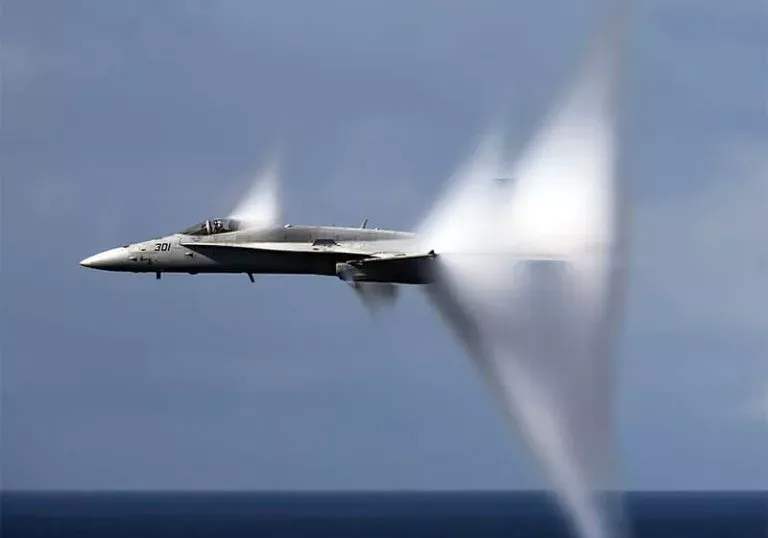
This is just an example of the formation of shock waves, the speed here is still subsonic
The correct answer is — more than 1 Mach. Or, Mach 1 is the speed of sound, and above Mach 1 is supersonic
The speed of sound is not a number we are used to seeing in kilometers per hour. To simplify, it can be explained as follows: the speed of sound depends on the properties of the medium in which it propagates. The denser the medium, the faster the waves travel (sound is a wave, after all). As a result, the speed of sound varies at different altitudes. The higher the altitude, the lower the air density and the lower the local speed of sound.
What is the speed of sound
The speed of sound is not expressed in kilometers per hour, simply because it would always be different. It is simply inconvenient.

Sound speed versus altitude
For example, the speed of sound near the ground (at 0 km) would be 340 meters per second (m/s), that’s 1225 km/h. And here it is important to say that such a value will be: at a temperature of +15 and a pressure of 750 mm. rt. Art. and 0% relative humidity. That is, under “standard” conditions. If the temperature is higher, the speed of sound in air will be lower, and so on, depending on conditions. Constantly different value.
But at an altitude of 10,000 meters, at which modern passenger liners fly, Mach 1 is already about 299 m/s (1076 km/h), that is, the difference is quite significant – 12%.
The resistance of the air also depends on the altitude of flight and other atmospheric parameters, and accordingly, the speed of the aircraft that it can develop.
- Speed 1 max = 1225 km/h at sea level at a pressure of 750 millimeters, temperature +15 and humidity 0%
- Speed 1 max = 1078 km/h at 10 km at the same temperature, pressure and humidity
The speed of sound at an altitude of 11 kilometers and above will almost not change. This part of the atmosphere is called the “tropopause”.
The same as a table
Speed of Sound*
| Height, m | Sound speed, m/s | Sound speed, km/h |
| -1000 | 344,1 | 1 238,8 |
| 0 | 340,3 | 1 225,1 |
| 1000 | 336,4 | 1 211,0 |
| 2000 | 332,5 | 1 197,0 |
| 3000 | 328,6 | 1 183,0 |
| 4000 | 324,6 | 1 168,6 |
| 5000 | 320,6 | 1 154,2 |
| 6000 | 316,5 | 1 139,4 |
| 7000 | 312,3 | 1 124,3 |
| 8000 | 308,1 | 1 109,2 |
| 9000 | 303,9 | 1 094,0 |
| 10000 | 299,6 | 1 078,6 |
| 11000 | 295,2 | 1 062,7 |
| 12000 | 295,1 | 1 062,4 |
| 13000 | 295,1 | 1 062,4 |
| 14000 | 295,1 | 1 062,4 |
*A moment of boredom. It should be recalled that, in fact, the speed of sound depends on height conditionally, this is a simplification. The speed of sound depends on the density of the atmosphere, and the density of air, in turn, depends on temperature, humidity and pressure, which change with height.
But all these numbers are for air. And in another environment, everything will be different:
- The speed of sound in water is 5335 km/h (in fresh water at 20 degrees Celsius)
- The speed of sound in sea water is 5420 km/h, and at a depth of 100 meters it is already 5286.6**
**The speed of sound in sea water increases non-linearly, does not change on the surface, then decreases, and then increases again. This is due to the fact that the temperature of the water in the sea also varies non-linearly. This phenomenon is called the thermocline.
No one, of course, has reached the speed of sound in water (the density is too high), but it is important for hydroacoustics.
The speed of sound in metal is about 18,000 km/h. Of course, in different metals it is different. The higher the density of the medium, the higher the speed of vibrations that can be transmitted. And sound is vibration. That is, sound travels in the form of a wave.
Why Mach number is needed
So, the Mach number in aviation is the ratio of the speed of an aircraft to the speed of sound at the altitude at which it is currently flying. It’s more convenient, because at different heights the speed of sound will be different, and in order to understand whether the aircraft reaches the speed of sound, its speed is measured in M numbers.
Mach One, that’s just Mach 1, not “km/h”. You can’t just answer the question “how much is 1 Mach in kilometers per hour”, you must always specify what height we are talking about.
Even more simply, the M number shows how many speeds of sound in the speed of the aircraft are now at a particular altitude (under certain environmental conditions). If the Mach number is greater than one, obviously we are dealing with supersonic speed. Therefore, most often you will find an explanation for what height a specific Mach number is indicated.
For example, for a Boeing 777, the cruising speed is Mach 0.84 (this is a subsonic aircraft). That is, at an altitude of 10,000 meters under standard conditions, taking the speed of sound as 1076 km / h, multiply it by 0.84 and get – 904 km / h.
According to the documentation, the Boeing 777 has a cruising speed of just 905 km/h.
As for supersonic aircraft, by definition, their speeds must be greater than the speed of sound, that is, more than 1 M. For example, for the Su-27 it is 2.35 M, which is approximately 2,528 km / h at an altitude of 10 km (the speed of sound is 295 m/s, which is 1062 km/h).
M number of some supersonic aircraft:
- Su-27 – 2.35 M
- Su-30 — 2.0 M
- Mig-31 — 2.82 M
- Eurofighter – 2.0M
- F-15 – 2.5M
- F-16 – 2.0M
- F-22 – 2.25M
- SR-71 – 3.3 M (3,529 km/h)
And here are hypersonic aircraft:
- Experimental hypersonic X-43A – 7.5 M (12,144 km/h)
- Experimental missile X-51 – 9.8M (12,144 km/h)

The SR-71 is the fastest production aircraft in the world.
One more thing, the Mach number in aviation is a qualitative value, not a quantitative one. That is, this is not speed in its pure form, but a criterion that shows how much the speed of an object is higher than the speed of sound. For what? Then what are subsonic, transonic, supersonic or hypersonic speeds are very different in essence.
The term “sound barrier” appeared just because at a speed of about or above supersonic aircraft behavior changes dramatically. Engineers and scientists had to work hard to understand exactly how to create an aircraft so that it flies well at both supersonic and subsonic speeds.
It is important for a pilot (and an engineer too) to know what mode of flow around the aircraft he currently has (subsonic, transonic or supersonic). For example, many speed gauges have a separate dial showing the Mach number value in addition to the airspeed.
The picture at the beginning of this story shows transonic mode. This means that the aircraft itself has not yet exceeded the speed of sound, and in some of its sections (in the photo it is very clearly visible by the white “wedges”), the flow speed has already reached the speed of sound.
This is why the shocks have been created and are clearly visible due to the formation of condensation behind them. That’s why the Mach number is so important.