Square-Cube Law
There are things shown in movies that are impossible in the real world: giant walking robots, Godzilla, giant insects, Spider-Man, people with wings like angels… All of this is “prevented” by one interesting law, which isn’t exactly a law — the square-cube law. Let’s figure out why some sci-fi ideas will never come to life.
The Square-Cube Law in Simple Terms
This is an empirical law, meaning it’s based on observation. It’s not about formulas or constants, so you can’t calculate something precisely with it, but it’s absolutely universal, simple, and understandable.
Here’s the gist:
If you increase the linear size of any object, its surface area grows proportional to the square, while its mass grows proportional to the cube!
Here’s an example:
-
- We have a cube with dimensions 1x1x1 meter. Its surface area is 6 square meters (each face is 1 m², and there are six faces), and its mass, let’s say, is 100 kilograms (made of foam).
- We double the cube’s size to 2x2x2 meters.
- The surface area increases 4 times to 24 square meters. One face’s area is 2×2=4, with 6 faces, so 6×4=24. Or 6x2x2 → 6 x 22.
- The cube’s mass increases 8 times to 800 kilograms. 100x2x2x2 → 100 x 23.

Look at the image; it shows that if you double the cube’s size (from one meter to two), you can fit eight cubes of the original size inside it.
Here’s the same thing in a table:
| Linear Size | Surface Area | Mass |
| 1 | 6 | 100 |
| 2 | 24 | 800 |
| 3 | 216 | 21600 |
| x | s2 | m3 |
| The square-cube law describes how changes in linear dimensions affect surface area and mass. | ||
Why Giant Robots Are Impossible
They’re impossible now and in the future because physics will always work the same way, as will economics. We’ve established that doubling something’s size increases its weight eightfold. But a giant walking robot would need to be the size of a house, otherwise, how is it giant?
At least as tall as a ten-story building! Let’s roughly calculate how much such a robot would weigh.
The Atlas robot from Boston Dynamics weighs 90 kilograms at a height of 1.5 meters. A five-story building is 30 meters tall—conveniently, that means scaling the small robot up 20 times.
Its mass would be 90×203, so 90x20x20x20=720,000 kilograms, or 720 tons.
Roughly, the foot area of the Atlas robot is 0.05 square meters, so two feet are 0.1 square meters. This area increases proportional to the square. So:
0.05x20x20=20 square meters for one foot.
Now, let’s calculate the most interesting part—specific ground pressure. P=F/S (weight divided by the support area)
720/20×2=18 tons per square meter!
What does this mean?
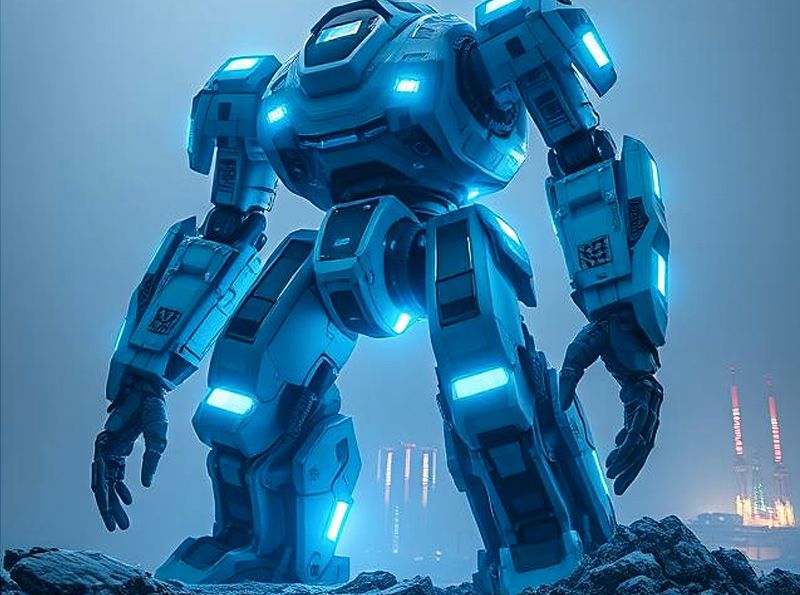
Such a robot couldn’t walk just anywhere; it would need dry, solid ground or a road, or it would sink while walking. It’s like letting a small Atlas walk through a swamp—it would get stuck and couldn’t move.
Here’s the load different road materials can withstand:
- Wet soil or sand — 100 kPa or 10 tons per square meter
- Dry soil — 300 kPa or 30 tons per square meter
- Asphalt — 500–1500 kPa or 510–1530 t/m2
- Concrete — 5000–8000 kPa or 5100–8160 t/m2
- High-strength concrete — 10,000 kPa or 10,200 t/m2
With a pressure of 18 tons per square meter, the robot would definitely need to watch where it steps, or better yet, stick to city streets. It would be better to double the foot area (by the way, giant robots are often depicted with large feet). Even if the robot had four or six legs, it would still be incredibly heavy and exert significant ground pressure. There’s a solution—tracks. But then it’s no longer a walking robot.
And what about inertia, for example? If such a robot swings its arm, the enormous inertia would tear it off. You’d need very strong structures, which means more mass. No wonder in cartoons and movies, such robots move slowly; even animators understand that fast movements would look unnatural.
And how much would it cost to produce such a robot? It’s scary to even think about.
The main question is: why would you need such a robot?
Can it transport something? No, any wheeled or tracked vehicle would do better.
Maybe for military purposes? Again, no. The robot would be highly vulnerable; it’s large, easy to hit, and any hit would either disable a critical mechanism or knock it over. Add armor? But the larger the armored area, the heavier the armor, and the robot becomes even heavier (cubed!).
In the real world, giant walking robots are simply impossible. The square-cube law “prevents” their creation. More precisely, the law describes physical reality. It’s often not obvious, but the following examples will show that it’s always and everywhere like this.
Godzilla and Giant Insects
Giant animals would face the same problems as the robot above, plus additional ones.
For example, the first Godzilla in movies was 50 meters tall (to tower over buildings). Accordingly, such a creature’s mass would increase proportional to the cube of its height—roughly 3,000 or 4,000 tons!
The bones of real animals can’t withstand such loads; you’d need high-strength, lightweight alloys or some fantastical materials.
Heat exchange becomes an issue. Cooling occurs through surface area, which changes according to the square law, while volume changes cubically. So, massive cooling systems or sweating tons would be needed to avoid overheating.
For example, elephants have large ears for cooling; Godzilla probably has its dorsal spines.
But the most interesting part is that a living creature needs to eat!
An African elephant eats 300 kilograms of grass per day, spending 12 hours eating.
Godzilla, at its size, would need to eat 2,500 tons of meat or 6,000 tons of grass. For scale, that’s 8,000 cows or 600 football fields of grass.
Giant animals are an even more impossible phenomenon than giant robots.
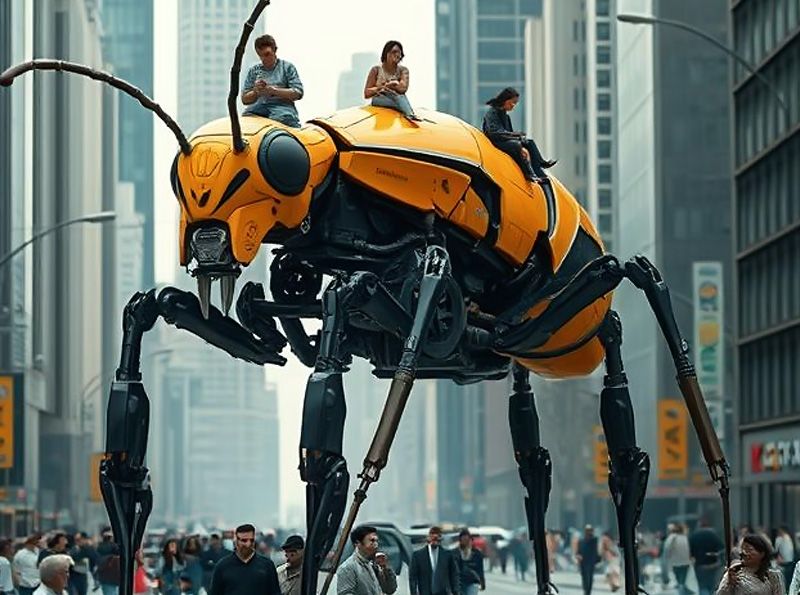
Such an insect taxi is impossible to create; its legs would break. Wheels are far more practical.
Insects have it even worse with size changes.
As they grow larger, they wouldn’t be able to walk. Despite having six legs, these are not under the center of mass like in animals or humans but extend outward from the body, creating additional static torque. At just 1 meter in size (far from “giant,” but such an ant would already be scary, right?), an insect’s legs wouldn’t support its body weight.
Plus, insects lack lungs. At a larger size, they couldn’t breathe. They simply have no way to draw in enough air, which a large insect would need more of.
300 million years ago, large insects (40 centimeters long) inhabited the Earth, but back then, the atmosphere had 1.5 times more oxygen.
The Square-Cube Law in Nature
Why Don’t Children Get Cold?
You’ve probably noticed that children get cold less often than adults. When a mother is already cold, her child isn’t yet.
It’s simple—the same law at work.
Our heat dissipates proportional to surface area. The larger the area, the faster we lose heat and start to feel cold.
A five-year-old child’s body surface area is about 0.7 square meters, while an adult’s is 1.8—over 2.6 times larger. So, an adult will get cold faster, assuming both are dressed similarly.
At this age, a child’s height is about 1 meter, while an adult’s is 1.75—only 75% taller, not twice or 2.5 times taller.
The same goes for weight. A child weighs about 16 kilograms on average, an adult 70—4.4 times more!
Why Can an Ant Lift 10 Times Its Weight?
Because an ant is tiny. The square-cube law works in the opposite direction too.
For example, a grasshopper can jump 40 times its body length! A horse, however, jumps no farther than its own length. An elephant doesn’t jump at all—it’s too heavy.
For the same reason, insects have small wings and thin legs. A bumblebee scaled to the size of an airplane wouldn’t fly, and a giant ant couldn’t lift any load—it wouldn’t even support its own weight.
Why Don’t Humans Fly Like Birds?
If a human grew wings like a bird’s, their wingspan would need to be about 7–8 meters to fly. More precisely, to glide, as flapping such wings would be impossible. Angels are usually depicted with a wingspan of 4–5 meters, but it would need to be twice that!
For comparison, a 4-meter wingspan is that of an albatross, which weighs only 10 kilograms.
For the same reason, we fly on fixed-wing airplanes, not ornithopters. Building a large ornithopter won’t work. The only ornithopter that lifted a human had a wingspan of 32 meters! And it didn’t flap like a bird but slightly bent its wings. A real Aero AT-3 airplane with a 7.5-meter wingspan lifts itself and two passengers because it has an engine and doesn’t need to flap.
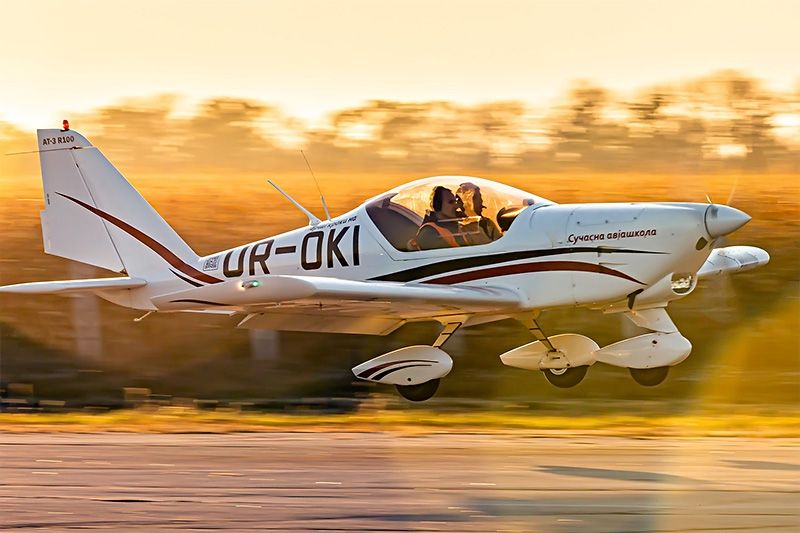
Aero AT-3 wingspan – 7.55 meters
Applications of the Law in Physics
Why Is Building Tall Buildings Difficult?
The square-cube law also applies when constructing tall buildings.
Doubling a building’s height increases its mass eightfold, requiring different wall materials and a completely different foundation. Heating and cooling also become problematic.

A building’s surface area, through which cooling or heating occurs, grows according to the square law, while volume grows cubically. But it’s the volume that needs to be cooled or heated! This requires powerful air conditioning systems.
The air conditioning system of the world’s tallest building, Burj Khalifa, has a capacity of 53 megawatts. This is comparable to running an airliner’s engine 24/7 to ventilate the building.
Why Is It Hard to Make Airplanes Larger?
Building large airplanes is much harder than small ones. Lift depends on wing area. If we decide to double the lift to carry twice as many passengers, the airplane’s mass would need to quadruple.
Mass increase forces more powerful engines, higher fuel consumption, and the use of stronger, ideally lighter materials. Simply scaling up an airplane is impossible; the benefits are “eaten” by the cubically increased weight, so the airplane must be redesigned from scratch.
The Boeing 787 Dreamliner’s wing has no rivets, saving half a ton. The wing is made of composite materials; to reduce weight and increase size, stronger, lighter materials were needed.
Why Can’t We Build a Large Spaceship?
The main obstacle is the mass of the structure. If we want a large spaceship to carry many people, it will have a large volume and mass. This mass must be launched into space. Cargo mass grows cubically, so the fuel mass needed to reach orbit grows the same way.
Obviously, materials for construction must be sourced in space to avoid hauling them from Earth.
But cooling in space is a bigger challenge than on Earth.
The International Space Station’s radiator area is 1,200 square meters, housing a maximum of 5–6 people. To colonize a planet without the colony dying out, you’d need to send 400–500 people.
The biggest problem is inertia!
In most space movies, spaceships behave like airplanes or ships: when engines are turned off, the ship stops. That’s more familiar to us, but it’s not true.
In space, when the engine is turned off, a spaceship doesn’t stop—it just stops accelerating. Sounds like good news: no resistance, accelerate, and keep going. But at some point, you need to stop, and there’s no resistance!
This means braking requires as much energy as accelerating. The higher the mass, the higher the inertia. Doubling a spaceship’s size increases its mass eightfold, so inertia increases eightfold too! And you’d need that much more energy for acceleration and braking!
In Conclusion
Size matters! Every time people create something large, it’s a truly significant step in engineering and economics. You can’t just scale up a bridge, airplane, or building height — you must respect the square-cube law.


