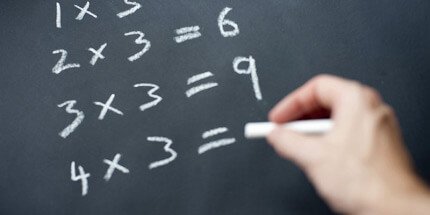
Multiplication table
Not everyone knows it, but surely everyone learns it in school. The multiplication table is a very useful thing even today in the era of artificial intelligence and calculators on phones.
Who invented the multiplication table
It is commonly believed that it was Pythagoras, the ancient Greek mathematician who proved the theorem about right triangles. However, archaeologists have found multiplication tables that were created before Pythagoras and not in Greece. The first such finding is about five hundred years older than Pythagoras and was discovered in Babylon.
Interestingly, this multiplication table looked completely unfamiliar because Babylonian mathematics was based on a sexagesimal system, not the decimal system.
The decimal multiplication table was discovered in China, but it is highly unlikely that Ancient China had stable connections with Ancient Greece.
Whether Pythagoras actually invented the multiplication table is unknown. There are no surviving documents proving this, and the Greeks of that time did not use the digits we now call Arabic.
However, in many languages, the multiplication table is named after the famous Greek mathematician.
- Tavola pitagorica (Italian)
- Tabla de Pitágoras (Spanish)
- Tabuada de Pitágoras (Portuguese)
The mathematician Nicomachus of Gerasa asserts that Pythagoras invented the multiplication table in his work “Introduction to Arithmetic.” But Nicomachus himself lived 600 years later and was a follower of the Pythagorean school of philosophy.
Therefore, it is likely that he simply invented it. The true authorship of the multiplication table cannot be definitively determined; who first created it is still unknown.
But there is another, more plausible and logical version. The first to create the multiplication table were Indian mathematicians.
This version is supported by the fact that it was the Indians who created the digits we use today. The Arabs called them “Indian,” and we now refer to them as Arabic. This is because these digits passed into Europe through Arab traders.
It is believed that multiplication as a mathematical operation was also invented in India in the 1st century AD. It is also known that multiplication in columns, the concept of zero, and negative numbers were described by the Indian astronomer Brahmagupta.
It is unlikely that he created three methods of multiplication without relying on older knowledge. It is more likely that the Indians who invented multiplication also invented the table to simplify calculations.
Why learn the multiplication table
The multiplication table simply makes calculations easier; it’s a convenient tool. After all, multiplication is just summing numbers several times. For example, 6×6 = 6+6+6+6+6+6 = 36; it’s easier to remember how much “6 times 6” is than to sum six sixes every time.
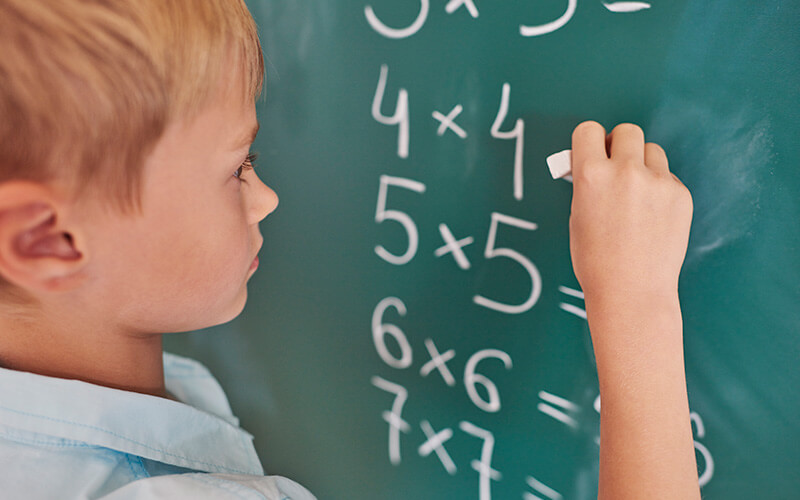
The multiplication table began to be taught in schools in England. This is not surprising, as the country was the most progressive and was already on the verge of the Industrial Revolution.
Interestingly, in China, the multiplication table looks different; for example, there is multiplication by 1, and the sequence of digits in the outer cells is different.
| 1 | 1 | ||||||||
| 2 | 2 | 4 | |||||||
| 3 | 3 | 6 | 9 | ||||||
| 4 | 4 | 8 | 12 | 16 | |||||
| 5 | 5 | 10 | 15 | 20 | 25 | ||||
| 6 | 6 | 12 | 18 | 24 | 30 | 36 | |||
| 7 | 7 | 14 | 21 | 28 | 35 | 42 | 49 | ||
| 8 | 8 | 16 | 24 | 32 | 40 | 48 | 56 | 64 | |
| 9 | 9 | 18 | 27 | 36 | 45 | 54 | 63 | 72 | 81 |
| × | 1 | 2 | 3 | 4 | 5 | 6 | 7 | 8 | 9 |
How to memorize the multiplication table
You can quickly and easily memorize the multiplication table, you just need to find the method that works best for you. The oldest method of learning is, of course, repetition. Repeat it many times until neural connections are formed in the brain and the table stays in memory for a long time. It won’t be memorized forever if these skills are not used; they will be forgotten.
However, if you need to calculate constantly, the knowledge will remain as long as it is needed.
| 2 | 3 | 4 | 5 | 6 | 7 | 8 | 9 | 10 | |
|---|---|---|---|---|---|---|---|---|---|
| 2 | 4 | 6 | 8 | 10 | 12 | 14 | 16 | 18 | 20 |
| 3 | 6 | 9 | 12 | 15 | 18 | 21 | 24 | 27 | 30 |