Why does an airplane fly
Why does an airplane fly? The question might seem childish. But try to answer it, and there’s a high chance your answer will be incorrect.
The truth is, the question is more complex than it seems, and there can be more than one correct answer.
Flight is actually a very complex process. Despite birds and insects doing it for millions of years, humans only learned how relatively recently.
Why an Airplane Flies in Simple Terms
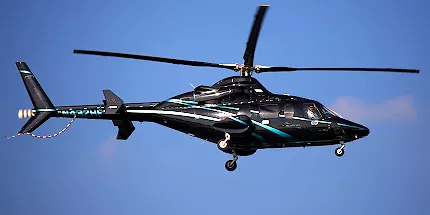
So, why does an airplane fly? In simple terms, an airplane or helicopter flies because it has wings!
A helicopter’s rotor is also a wing — it just rotates.
A wing is any aerodynamic surface that generates lift. This lift is only created during motion, when airflow passes over the wing. To achieve the speed needed to generate lift, an airplane needs an engine.
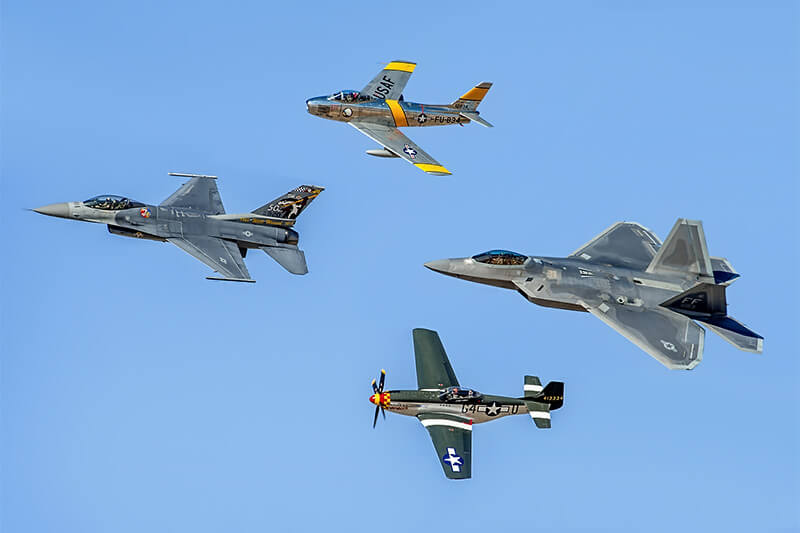
Why Does an Airplane Need Wings?
We need to dive deeper into how a wing generates lift, or in other words, the force that lifts the airplane into the air.
It’s all because the upper surface of the wing is larger than the lower one. If you slice a wing, you’ll see that the upper edge is longer than the lower one. That’s the key thing to know about a wing.
Air flows faster over the upper surface than the lower one, accelerating as it passes.
The same effect can be seen in any stream or river: when the channel narrows, the water flow speeds up. It’s the same with a gas flow.
Where air moves faster, its pressure is lower. Pressure is the force of gas molecules colliding, and if the flow is faster, the molecules collide less frequently.
So, the pressure above the wing is lower, and below the wing, it’s higher. This causes the wing to move toward the lower pressure—upward. This is the lift generated by the wing, thanks to its asymmetrical shape.
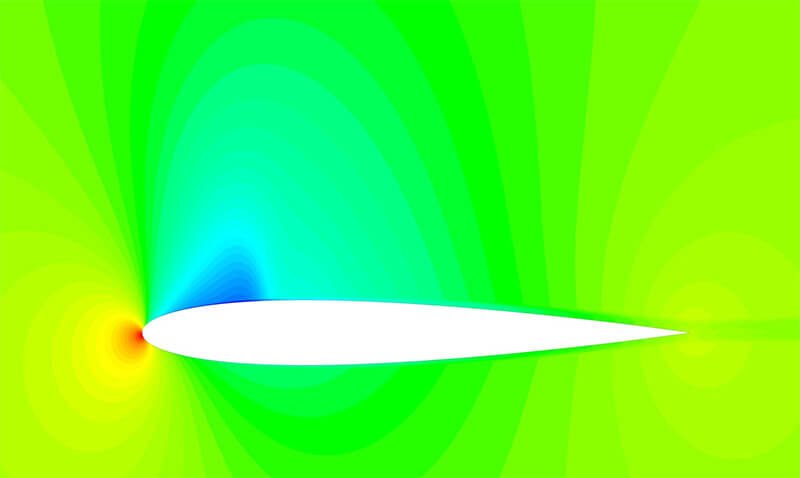
Pressure gradient: the “warmer” the color, the higher the pressure. The highest pressure is in front of the wing, the lowest above it.
Everything written above is a very simplified explanation of Bernoulli’s principle.
This is a highly simplified explanation of the physics. In reality, it’s not quite like that…
The real process is far more complex, but to fully understand it, you’d need at least a degree from a specialized university department. For a general understanding, you don’t need to spend years studying. So, we simplify. Otherwise, we’d have to explain pressure gradients and essentially contradict everything said above.
The key point is that the essence doesn’t change: to understand why a wing generates lift, you only need to know that the pressure above the wing is lower than below it.
You can increase lift in several ways:
- Fly faster. The higher the speed, the greater the pressure difference and the higher the lift. But this also increases drag.
- Increase the angle of attack*. That is, raise the airplane’s nose to further increase the wing’s “curvature.”
- Modify the wing itself. For example, extend flaps (which change curvature and increase surface area) or adjust the sweep angle if the airplane has variable-sweep wings.
*The angle of attack is the angle between the wing’s chord and the direction of airflow. In simple terms, during takeoff, the airplane “raises its nose” but moves parallel to the ground, not upward. At this moment, the angle of attack is greater than during level flight.
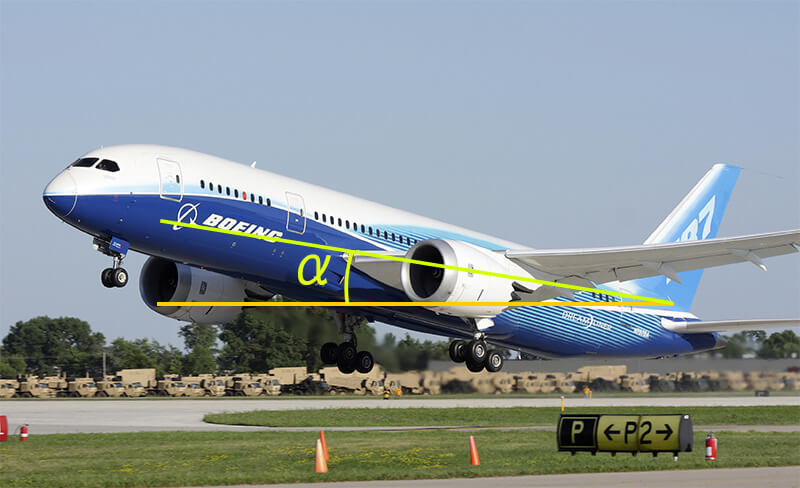
The angle of attack is typically denoted by the Greek letter “alpha.”
So, an airplane flies because its wings generate lift. A helicopter also has a wing—its rotor. The rotor’s lift is created the same way as an airplane’s wing, except the helicopter’s rotor rotates, while an airplane’s wing is fixed.
Why an Airplane Flies: The Physics of Flight
Why does an airplane fly and not fall? That’s a slightly different question. Because the lift is greater than or equal to its weight.
Weight is the force pulling the airplane downward, while lift pulls it upward. When lift exceeds weight, the airplane climbs, when it’s less, it descends. If the forces are equal, it flies level.
It seems simple, but in reality, the forces acting on an airplane are constantly changing.
For example, as speed increases, the aerodynamic focus (the point where all resultant lift forces are applied) shifts, while the airplane’s center of mass stays in place. This creates a diving moment, causing the airplane to “nose down.”
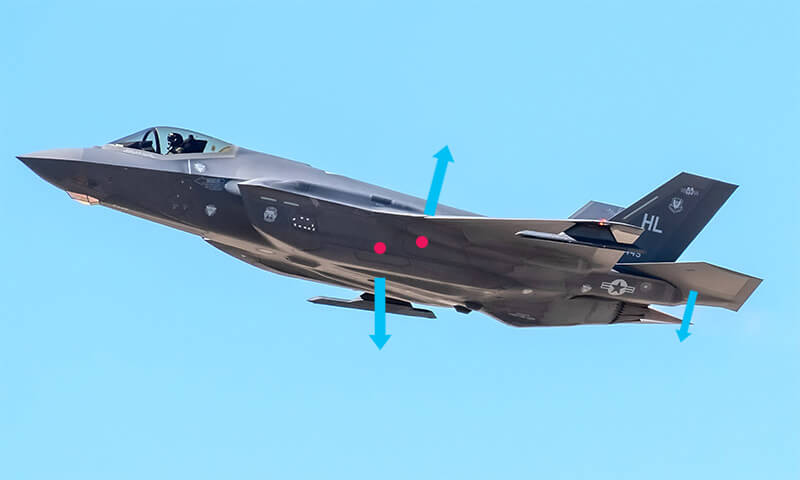
Forces acting on an airplane: the focus of lift and the airplane’s weight are centered at different points.
As the airplane approaches the speed of sound, the effect of the shifting aerodynamic focus becomes noticeable and dangerous.
Weight also changes because engines burn fuel, making the airplane lighter. However, fuel systems are typically designed to burn fuel evenly from different tanks to keep the center of mass in the same place.
Flight during level flight differs significantly from takeoff and landing. To increase lift for takeoff, the pilot increases the angle of attack and extends flaps, as the speed during takeoff is much lower before the airplane accelerates.
To control or balance the flight, vertical and horizontal stabilizers (tail) and ailerons on the wings are typically used. However, there are aerodynamic designs where the horizontal stabilizer is placed in front (canard configuration), there’s no tail at all (tailless configuration), or there’s neither a tail nor a fuselage, with the entire airplane being a wing (flying wing configuration).
But an airplane always has a wing—it’s what makes it fly.
And most often, there’s just one wing! Most modern airplanes are monoplanes, with a single wing. Biplanes, have two wings.
Why Airplanes Fly at 10 km Altitude
Airplanes fly at the altitude that is most economical. This could be 10 or 11 kilometers, slightly higher or lower. Some military aircraft can climb to 20 or even 30 kilometers, but they usually fly at roughly the same altitude as passenger airliners.
The thing is, at this altitude, the air is dense enough to generate wing lift and supply oxygen for fuel combustion in the engine, while also being thin enough to minimize drag.
Lower drag allows for higher speeds and lower fuel consumption.
An altitude of 10 kilometers is simply the optimal height for economical flight with modern turbojet engines. In the past, when airplanes had piston engines, they flew much lower.
Why Doesn’t an Airplane Fly in a Straight Line?
It depends on how you look at it. Relative to the air, an airplane in level flight does fly straight. But relative to the ground, it doesn’t.
Since the Earth isn’t flat (which might surprise some), an airplane flies along an arc. For example, if it maintains a constant altitude of 10,000 meters above the ground, it’s actually flying parallel to an arc, not straight. That’s why airplane speed is easier to measure in knots rather than kilometers per hour.
One knot is the same as a nautical mile per hour, where a “nautical” mile is the length of an arc equal to one minute of the equator.
As for the flight path, airplanes sometimes don’t fly directly from point A to point B. Although it seems simple—there are no roads or obstacles in the sky, so why not fly straight?
There are several reasons: avoiding areas unsafe for flight, safety requirements when flying over oceans (an airplane must be able to reach an alternate airport within 180 minutes in case of engine failure, known as ETOPS-180), or the need to approach a specific runway, as not all runways worldwide are aligned.
Why Doesn’t an Airplane Flap Its Wings?
It doesn’t need to. Birds don’t always flap their wings either—only when they need to accelerate or take off. An airplane has an engine for that. Insects, however, constantly flap their wings, but we’ll talk about the difference between insects and birds later.
Attempts have been made to create wing-flapping airplanes, but such designs are less efficient. An airplane that flaps its wings is called an ornithopter or entomopter. The former mimics bird flight, the latter insect flight.
In Frank Herbert’s book *Dune*, ornithopters are described, but in the *Dune* movie, they’re actually entomopters.
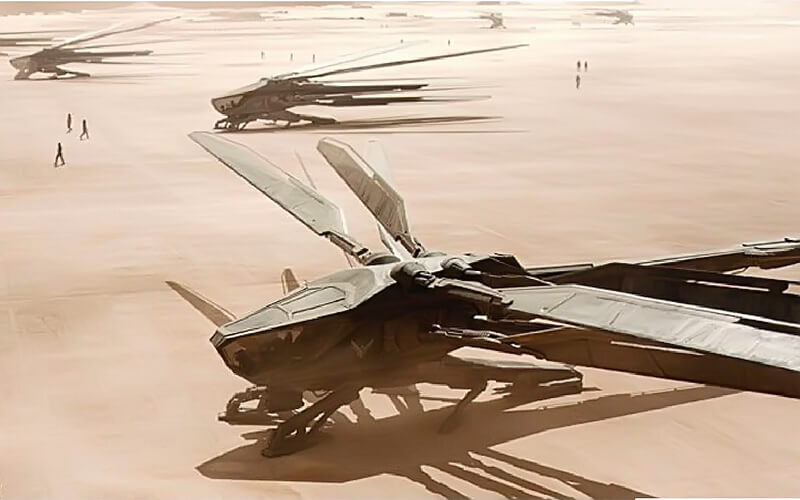
The ornithopter from the movie *Dune* is actually an entomopter. It flies like a dragonfly, not a bird.
Ornithopters are usually made very small because an airplane-sized device simply wouldn’t fly—it’s too heavy. The only wing-flapping aircraft that lifted a human had no engine, it flapped its wings using human muscle power because an engine for such a craft was too heavy.
The thing is, a bird’s wing flap results from muscle contraction. Airplanes don’t have muscles, so mimicking a bird’s wing movement requires a complex mechanism, adding weight. On the other hand, birds don’t have jet engines or propellers, which would make them fly better.
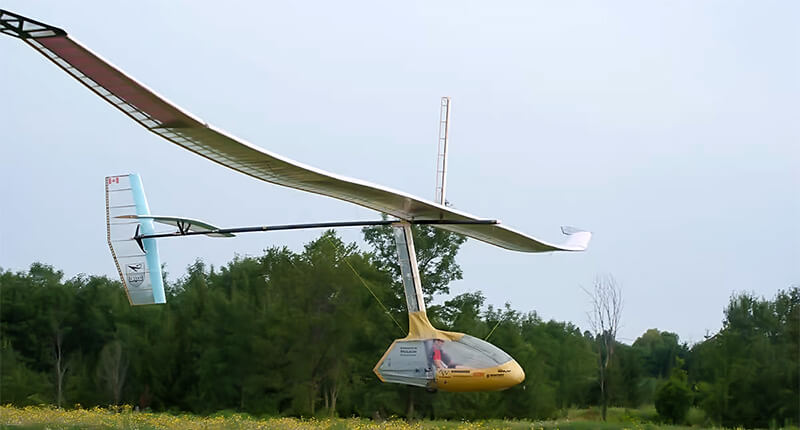
The only truly flying ornithopter
Also, the more moving parts, the more likely a mechanism will break, and a flapping wing faces enormous stress. So, it’s better for an airplane to have fixed wings and an engine than to “learn” to flap like a bird. A bird’s wing is flexible and elastic.
The aircraft in the photo above, for example, has only one moving segment, placed farther from the wing root to reduce stress on the mechanism.
The largest flying bird, the condor, weighs up to 15 kilograms. Compare that to an airplane’s weight, measured in tons. Heavier birds simply don’t fly. Building a large ornithopter, if not impossible, is much harder than a classic airplane or helicopter.
The same applies to entomopters. An insect’s wing is far smaller than what an airplane needs to fly. You can’t just scale an insect to airplane size (due to the square-cube law). No materials could withstand the stress on such an aircraft’s wing.
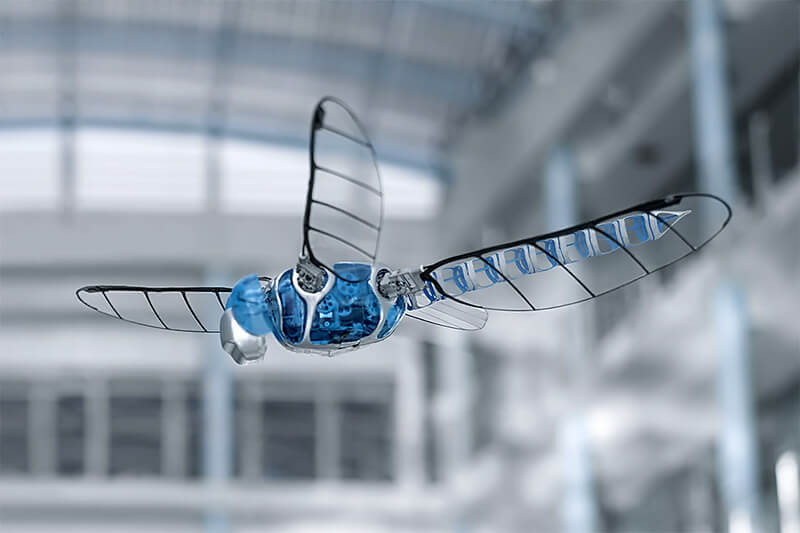
The BionicOpter dragonfly robot weighs only 175 grams, making it significantly larger isn’t feasible.
In the end, what works well in nature is poorly suited for machines, and vice versa.
The aerodynamic efficiency of an ornithopter is around 10–12 units, while a Boeing 737 passenger airplane achieves 15, and gliders often exceed 50.
As for real wing-flapping aircraft, they’re usually built small, making them unable to carry cargo or people. Perhaps in the future, humanity will invent materials that increase strength or reduce weight (or both). But not today.
In Conclusion
Now you know why an airplane flies—not in the sense of “it flies through the sky,” as the old joke goes, but the principle behind how and why it’s possible. Only two things are needed for flight: a wing and speed. Flapping wings isn’t necessary and is even counterproductive. An airplane needs wings because without them, it doesn’t fly. If it flies without wings, it’s not an airplane but a dirigible or hot air balloon, which don’t fly but “float,” literally using the Archimedes’ principle, like ships at sea.