Stealth technology
In fact, it’s a very simple idea. But it has become so shrouded in myths that to most people it seems like something highly complex, secret, and mysterious. How does stealth technology actually work?
To begin with, it’s worth debunking the main myth related to its definition. Aircraft designed with stealth technology are often called “invisible planes”, which has led to the misconception that it’s all about invisibility. That’s not entirely true.
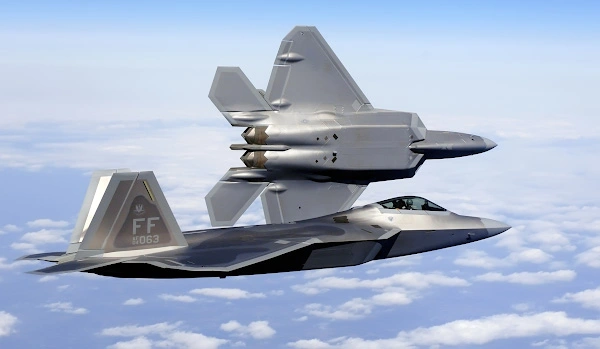
F-22 “Raptor”
Invisible Plane?
What is stealth? Since the technology was first applied in the USA, the term “stealth” comes from English, where it translates to “cunning” or “furtiveness”, and “by stealth” means “unnoticed by others” or “secretly”.
So, there’s no talk of invisibility even in the name, the meaning of “stealth” is different. It’s about being unnoticed or minimally noticeable.
The correct way to describe it is:
- “low observable technology” or
- “technology for reducing detectability in radar and infrared ranges”
Because that was the whole idea—everyone understood that making an aircraft completely invisible was impossible.
The term “invisible plane” is a journalistic cliche. it sounds cool but has little to do with reality.
How Stealth Technology Actually Works
All measures used to reduce detectability can be divided into several approaches.
It depends on which devices we want to deceive. In the past, when it was just about the observer’s eyes, camouflage was used. Today, it’s primarily about radar.
How to Deceive Radar
Any object becomes visible to a radar station (RLS) only when an electromagnetic wave reflects off it and returns to the receiving antenna.
Our eyes work the same way, except that the wavelength of visible light ranges from 450–630 nanometers (0.000000001 meters), while radar frequencies range from 690–405 terahertz (tera is 1,000,000,000,000, or “trillion”).
Radar uses the same electromagnetic waves, but with wavelengths from 0.02 to 0.3 meters and frequencies from 1 to 3 gigahertz (giga is 1,000,000,000, or “billion”).
Thus, the oscillations differ by orders of magnitude in frequency and wavelength. But they are still electromagnetic waves and obey the same laws.
So, to deceive radar, you simply need to avoid reflecting its radiation.
There are two tricks:
- Use radar-transparent (for that radiation) materials (e.g., carbon fiber or wood).
- Or use radar-absorbing materials.
Both options are possible and have been used in practice for a long time. But there’s a third, more cunning approach:
Reflect the waves anywhere but back toward the radar antenna. This doesn’t require special coatings. It can be achieved by changing the object’s shape.

F-35A. Another “invisible”
There’s another obvious method—reducing the object’s size, but there’s not much to say about it. A smaller aircraft will be less noticeable than a larger one.
Of course, it’s also important not to “shine”—to emit minimally or not at all. The easiest way to achieve this is by turning off the aircraft’s own radar.
How to Deceive Thermal Imaging
The second type of radiation is infrared. An aircraft can be detected and shot down using its heat signature, as it differs in temperature from the surrounding environment.
The gas temperature in an aircraft turbine engine can reach 1,700–1,800 degrees Celsius. This means such an aircraft can be detected and attacked from tens of kilometers away.
But countermeasures have been developed, of course. The solution is obvious—reduce the aircraft’s (or other equipment’s) heat signature.
To reduce detectability in the radar range, the following are used:
- Special coatings (radar-absorbing or radar-transparent) and similar components in the structure.
- A shape that reflects radio waves in a different direction.
- Shielding of compressor and turbine blades.
- A design that avoids “bright spots” (areas that strongly reflect radio waves).
To reduce infrared detectability, the following are typically used:
- A special nozzle shape and shielding (to reduce visibility from certain angles, e.g., from below).
- Special fuel or additives to it.
Clearly, it’s impossible to completely eliminate the reflection of radio waves, just as it’s impossible to become a perfect black body (in the infrared range). But that’s not necessary.
Even reducing the power of the signal returning to the radar antenna or hitting the infrared missile’s sensor helps the aircraft remain undetected longer.
Remember, no one ever intended to build invisible planes, engineers always aimed to create low-observable aircraft, not completely invisible ones.
A low-observable aircraft or ship can approach closer before being detected or escape pursuit more quickly.
Its signature (the radar “fingerprint” of the reflected signal) is harder to distinguish from background noise. That’s the whole point of stealth — being unobtrusive.
But this is all a superficial and simple explanation of low-observable technology. It gets more interesting.
History of Stealth Technology
Radars for detecting aircraft and ships began to be used during World War II.
But in most cases, it was only about detecting the enemy, while aiming and shooting still relied on human vision.
However, radars improved, and soon it became possible to guide missiles at much greater distances than the human eye could see. Previously, camouflage helped remain unnoticed. Now, mottled coloring was no longer a defense.
First Attempts
The first aircraft to deliberately use stealth technology principles was the legendary Lockheed SR-71 Blackbird.
As a reconnaissance aircraft, it was meant to be low-observable by definition.

SR-71. The tilt of the tail fin is not accidental
What exactly was used in the SR-71, what methods and technologies for low observability?
Firstly, materials. For the first time in aviation, radar-absorbing coating was used (both as ferromagnetic paint and as specially developed materials for the aircraft’s skin).
The first radar-absorbing material was developed in Germany during World War II. But it was used for the snorkel (exhaust pipe) of submarines to remain unnoticed by Allied anti-submarine aircraft.
The fuselage’s special shape, which scatters the reflected signal, also stands out, as does the tail fin, tilted at an angle greater than 90 degrees to the fuselage.
An ideal reflector is considered a “corner reflector” because it reflects the signal directly back. A corner reflector is a shape where all three planes are perpendicular.
One of the simplest ways to reduce radar detectability is to avoid right angles.

Corner reflector, principle of operation
Another trick: Special additives were added to the SR-71’s fuel to reduce the exhaust temperature.
But the first attempt wasn’t entirely successful. The problem lay in the project’s essence. The SR-71 reconnaissance aircraft was the fastest not only in its class but in the world.
By the way, its speed record of 3,529.56 km/h remains unbeaten to this day.
Thus, its shape couldn’t be altered too much, or aerodynamics would suffer. Its impressive speed was considered a better defense than stealth.
But it became clear in practice how the “invisibility” technology worked. And it worked well.
First Stealth Aircraft
The second attempt was the Lockheed F-117 “Nighthawk” (developed by the same Lockheed Martin). Although its designation includes the letter F, typically meaning Fighter, it was a 100% frontline bomber.
This time, the focus was not on speed but on maximum stealth. This marked the beginning of a new era of “pure” stealth aircraft.
The American “invisible plane” is truly unique.
First of all, the bomber’s faceted shape stands out. Flat facets reflect waves anywhere but toward the radar.
Anyone can take a ruler and, recalling the rule “angle of incidence equals angle of reflection”, verify this themselves.

How is low observability achieved? Geometry!
The same stealth technique, on a smaller scale, is the sawtooth edging of the cockpit and anything that opens/closes. This is done for the same reason—to scatter the signal reflected from these edges.
No unnecessary details that could form a 90-degree angle. All weaponry is hidden in an internal compartment, with no external suspensions.
Air intakes are covered with grilles at the front and positioned above the wing so ground-based radars cannot “see” into the engine’s compressor, whose blades perfectly reflect radio waves, and their shape or material cannot be altered.

F-117A. The first true “Stealth”
The same applies to the rear, the engine nozzles are above the wing and additionally covered with ceramic tiles to reduce heat.
But the main innovation is the flat engine nozzles. This shape allows exhaust gases to cool much faster than a round nozzle would.
Of course, ferromagnetic paint wasn’t forgotten. Even the cockpit glazing had a metallic coating to prevent reflections from internal cockpit parts.
It’s believed that these techniques reduced the effective scattering area (RCS) to 0.025 square meters.
RCS is a measure of the area that actually reflects the signal. An object with an RCS of 2 square meters will have the same detectability to radar as a piece of metal of the same area. Note that RCS varies by direction. Usually, the minimum is specified, from the “front view.”
Everything in this aircraft’s design was aimed at reducing radar detectability (and thermal too), sacrificing everything: speed, maneuverability, and payload.
For its flight characteristics, the F-117 earned the nickname “Wobblin Goblin”. Engineers abandoned the use of its own radar to avoid revealing its presence. The only weapons were laser-guided bombs, with the primary mission being to penetrate and suppress air defenses.
Pinnacle of Technology — B2
The next step was creating a strategic “invisible” bomber. The task was taken on by Northrop B2 (Lockheed’s team lost the competition).
This time, the aircraft had no tail fin at all. It was the world’s first true flying wing. All possible tools and techniques for low observability were used:
- Placement of engines above the wing and flat nozzles.
- Special wing shape, “clean” contours (no protruding parts, including antennas, rivets, or grilles).
- Large skin panels (to reduce the number of seams).
- Sawtooth seams where they exist.
- Smooth integration with engines and “fuselage” (and no right angles).

Smooth shapes of B-2 vs. grilles, seams, and antennas of F-15
For the first time, S-shaped air intakes were used to reduce radar detectability, so there are no grilles at the front of the engines.
At the rear, the turbine blades are covered by a more sophisticated device—a radar blocker.
Radar Blocker
A radar blocker is a device that helps conceal the turbine or compressor blades.
Obviously, changing the blades’ shape for stealth is impossible, as the engine would stop functioning properly. Coating them with radar-absorbing materials is also futile—high temperatures or dynamic loads would destroy the coating.
So, engineers prefer to install additional vanes before the compressor or after the turbine to hide the blades or redirect radio waves elsewhere.
Naturally, radar-absorbing materials were used in the structure, along with similar coatings in the form of paint and even special coatings for the cockpit glazing.

Radar-absorbing coating is protected, personnel walk only in shoe covers
There was no single hallmark of stealth technology—no tilted tail fin, as it was absent altogether.
In the case of the B-2, they managed to avoid the intimidating faceted surfaces, the wing looks like a true wing.
The thing is, since the F-117, information technology had advanced, enabling the calculation of smooth curved surfaces (second-order curves).
Modern “Invisible Planes”
The F-117 program was officially terminated in 2008, with major funding cut earlier, redirected to the fifth-generation fighter program—ATF. Having tested stealth technology on bombers, they moved on to fighters.

Prototypes. YF-22 by Lockheed/Boeing and YF-23 by Northrop. This photo clearly shows the parallelism of wing and tail fin edges
A fighter is not a bomber! You can’t sacrifice flight characteristics. It needs to be fast, maneuverable, and low-observable at the same time.
This time, competing teams included Lockheed + Boeing + General Dynamics with the YF-22 prototype and Northrop + McDonnell Douglas with the YF-23. Lockheed’s engineers won the top prize and a contract to build 382 aircraft.

F-22 Raptor. Flat engine nozzles
However, far fewer were built—only 187 (excluding experimental units).
To ensure low observability, all known stealth techniques were used without compromising aerodynamics:
- Wave-scattering shape.
- Smooth integration of wing and fuselage.
- Coatings and materials.
- Large components.
- Minimal gaps at seams.
- Flat nozzles.
- S-shaped air intake channels at the front, radar blockers at the rear.
- Sawtooth hatch and panel edges…
Looking from above at both prototypes, it’s noticeable that the wing and tail fin edges are parallel to each other. The same applies from the front view—the vertical tail fins are parallel to the air intake lines.
This all serves the same purpose—reducing the radar signature by reflecting the signal “somewhere else.”

F-22 from the front, parallelism of tail fin and air intake lines
If the edges were not parallel, the radio wave reflected from the wing and tail fin would have different directions, and some of the signal could return to the radar antenna.

YF-23 Black Widow
Overall, a vast array of stealth tricks was used. In addition to the techniques described, a seamless cockpit canopy (on the F-22) and extensive use of non-metallic materials (carbon fiber, ceramics, etc.) were added.
According to various sources, the share of composite materials in the structure ranges from 40% to 60%.
Things were less straightforward with the “junior” fighter, the F-35. It was designed in three variants, one of which was for vertical takeoff and landing.
This required tilting the single engine’s nozzle downward to generate lift. This, in turn, made it impossible to use a flat nozzle (which has higher losses than a round one).
There’s also no seamless canopy on the F-35. However, all other stealth features are present.

F-35, all signs of an “invisible plane”
Although the nozzle is round, it has a zigzag contour, and this isn’t for aesthetics.
Techniques for Reducing Detectability
Structural Solutions—Stealth Shapes:
- V-shaped tail fin. Tilted more than 90 degrees (ideally absent).
- Flattened fuselage shape (preferably no fuselage).
- Smooth integration of all structural elements (no 90-degree angles).
- “Clean” shapes (no protruding parts).
- Large skin panels to reduce the number of seams.
- Precise fitting of components.
- Sawtooth shapes for hatches, panels, and seams.
- Parallel edges in different projections.
- Seamless canopy.
- Internal weapon compartments.
Engineering Tricks:
- S-shaped air intakes.
- Radar blockers (grilles, vanes).
- Special radar operating mode (LPI).
Use of Materials and Coatings:
- Radar-absorbing coatings (paints).
- Radar-absorbing materials in the structure.
- Radar-transparent materials.
Reducing Infrared Detectability
- Flat nozzles, whose exhaust gases cool faster.
- Mixing exhaust with cold air streams diverted from the engine.
- Shielding hot zones from certain directions.
- Use of special materials and coatings that quickly dissipate heat.
- Special fuel additives or substances sprayed behind the combustion chamber to temporarily reduce gas temperature.
Not Just the USA, Not Just Aircraft

The Su-57 has not all low-observable elements (older engines)
The Americans were undoubtedly the first, but that doesn’t mean other countries aren’t paying attention to stealth technologies.
Their own “invisibles” are being developed with varying success in Russia: PAK FA/Su-57, and in China: J-20 and J-31. The Chinese, as expected, work faster and have already deployed a squadron, if not two, to their forces.
South Korea, Japan, and even Turkey are also applying the same principles in designing their prospective fighters.
And they apply them so well that at first glance, it’s very hard to distinguish the South Korean KF-21 Boramae from the Turkish KAAN. They all look very similar to the F-22.

Chinese J-20 designed in a canard configuration, some “experts” claim this contradicts low observability
Development is underway in countries such as:
- Japan (Mitsubishi X-2 Shinshin)
- South Korea (KAI KF-21)
- United Kingdom (Tempest)
- European consortium (NGF)
- Sweden (SAAB Flygsystem)
- Turkey (TF-X, KAAN)
- Iran (IAIO Qaher-313)

They all have much in common
Many projects use only some elements of stealth technologies.
For example, the French Rafale has 25% of its mass and 30% of its surface area made of composite materials (saving weight and reducing RCS), curved air intakes, fuel injection into the nozzle to reduce IR emissions, and, of course, elegant shapes with minimal protrusions on the surface.

French Rafale and its S-shaped air intakes
Stealth technology elements are used in the European Eurofighter Typhoon, the American carrier-based F-18 Hornet, and the Swedish JAS 39 Gripen.

Japanese low-observable prototype – X-2. A relative of all the previous ones
Low-observable cruise missiles and even bombs are being developed and have already been adopted.

Low-observable cruise missile AGM-158 next to the low-observable F-35
And stealth technologies aren’t limited to aviation. They can be found in naval applications and, to some extent, in ground equipment (mainly aiming to reduce thermal signatures).

Swedish “invisible” Visby-class corvette
And despite all this, there are still people who claim that stealth doesn’t work and invisible planes are actually visible.
The technology works, and how! It’s just physics and a bit of geometry.
Of course, it’s a fairly secretive topic. No one discloses the actual effective scattering area values of their aircraft, and Luneburg lenses are used to mask the true value by significantly increasing RCS. Little is known about radar-absorbing coatings either…
Numerous debates arise around stealth regarding radar operation, thousands of opinions about the quality of stealth paint, and the appropriateness of using plastic components.
The ground for myths about stealth technology is more than fertile. But the fact remains—thousands of scientists and engineers worldwide spend their time trying to reduce the detectability of military equipment. Would they be doing pointless work for so many years?




How does the common misconception of stealth aircraft as “invisible planes” obscure the true nature of stealth technology—which focuses not on visual invisibility but on reducing radar cross-section, infrared signature, and other detectable emissions—and why is this distinction critical for understanding modern aerial warfare, defense strategy, and the limits of current military concealment capabilities?