Emperor & Imperia
The word “empire” is used by everyone, everywhere. Usually, it means “something large,” for example: business empire or criminal empire. It’s interesting what the word empire actually meant in ancient times and what the emperor governed. And how the meaning of the ancient term differs from the modern one.
What is an Empire?
The first empire was, of course, invented in Rome. The Latin word imperium translates as “power,” “order,” or “term of office” (that is, the period during which governance takes place) and comes from the word impero, which means “to command” or “to govern.”

Octavian Augustus — the first Roman emperor
If we dig deeper, imperium is derived from im+paro. The root paro means “to prepare” or “to organize,” and the prefix im (in) indicates an action directed towards something.
- imperare – to command
- aliquo imperante – by someone’s order
- divide et impera – the famous phrase “divide and rule”
In fact, imperium for the Romans was governance, and those who govern (or rule, which is the same thing).
It’s interesting that…
The sacred boundary of the city of Rome was called the Pomerium, and everything beyond this boundary was Imperium. Inside the city, the laws of the Pomerium applied, while outside the city, the laws of the empire applied. Importantly, the emperor, that is, the commander of the army, was not allowed to enter the city with armed troops, except for a triumph, that is, a military parade. However, beyond the borders of Rome, the emperor’s power was limitless. There was no one higher than the commander; all power was in his hands.
In Ancient Rome, the empire was, in simple terms, the territories outside the city of Rome that were under Roman control.
Who is an Emperor?
So, who ruled inside the city of Rome? The Senate, in our understanding, was like a parliament. This was the case at first…
An emperor is a military official granted imperium — the authority to govern.
However, in its original sense, the title of emperor referred to the commander of the army who achieved great successes. Being named emperor did not give a Roman citizen any special privileges; it was an honorary title. The first such emperor was the conqueror of Hannibal — Scipio Africanus.

“The Magnanimity of Scipio” by Anthony van Dyck
In the modern sense of the word, an emperor is a ruler with unlimited authority, and such a person was Octavian Augustus — the first Roman emperor.
No, not Julius Caesar, as one might think, but his adopted son Octavian (his full name was Gaius Julius Caesar Octavian Augustus). During Caesar’s time, the Roman Senate continued to function formally, just as it did during Augustus’s reign, but now the emperor decided who would be a senator and who would not.
In less than 200 years, the meaning of the word emperor changed from an honorary, meaningless title to the title of a person with absolute power over the entire empire (including the city of Rome).
An emperor is a ruler with unlimited power.
Ancient Empires
Of course, empires as political entities existed before the Romans. The word “empire” itself did not exist, and the rulers of these states did not consider themselves emperors. It’s just that today, we conveniently call large states empires and their rulers emperors in the modern sense of the word.
The oldest known empires include the Babylonian, Assyrian, and Persian empires. However, the rulers of all these “empires” are traditionally called kings.
The Largest Empires in History
To make history more interesting, we should also mention the duration of each empire’s existence. That way, the size may not seem so big if the empire lasted only a short time and then fell apart.
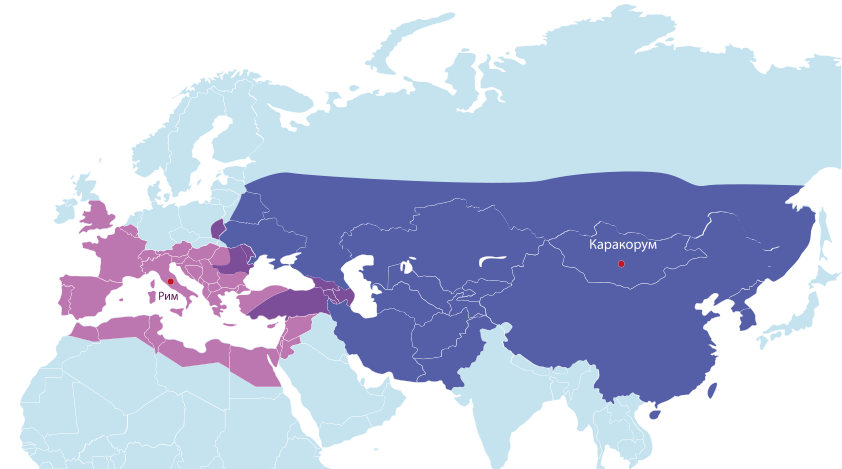
Comparison of the sizes of the Roman and Mongol Empires
The Empire of Alexander the Great
Officially, Alexander the Great held the title of king. But we call the state of Macedon an empire because it actually consisted of several smaller countries under the sole rule of Alexander himself.
The king’s power extended from modern-day Italy to modern-day Pakistan, covering an area of about 5.2 million square kilometers. By the way, after the ruler’s death, the empire fell apart, lasting only 33 years.
Alexander himself declared himself king of Asia, the son of a god, and even a god (in conquered Egypt). Of course, the title of emperor didn’t exist at that time.
The Mongol Empire of Genghis Khan
The Mongols succeeded a bit more. The Mongol Empire covered about 33 million square kilometers, and its rule extended over a quarter of the world’s population at that time. Never before had the world seen states of such size, and interestingly, it never would again. The Mongol Empire was the largest empire in history with unified borders.
The Mongol Empire lasted not much longer than the Macedonian one — less than 50 years. Genghis Khan died, and his legacy was immediately divided among his sons.
Interestingly, the Great Yassa of Genghis Khan contained a prohibition on declaring oneself an emperor without a decision from the kurultai (the Mongol assembly). Genghis Khan himself held the title of “Khan,” which translates as “great khan” or “khan of khans,” but in fact, it was equivalent to an emperor.

Mongol Cavalry
Roman Empire
A state formation that gave us the words “empire” and “emperor”. The classical ancient empire lasted for 503 years, beginning with Augustus and ending with Romulus Augustulus.
At the height of its power, it stretched from the west to the east, from modern-day Spain to Iran, and from Great Britain to Egypt in the south, covering about 4.8 million square kilometers.
After existing for just over 500 years, the Roman Empire collapsed. However, the Romans themselves were unaware of any empire’s collapse.
Byzantine Empire
The Eastern Roman Empire, at its height, covered an area of about three and a half million square kilometers. Its rulers logically considered themselves heirs to the same Roman Empire, calling their state simply the Roman Empire, and their people — Romans (i.e., citizens of Rome).
Compared to the earlier Roman Empire with its vast territory (4.8 million km2), and influence, it couldn’t compare. However, the Eastern Empire lasted a little longer than the unified one — 1049 years versus only 503 years of the classical unified Roman Empire.
Charlemagne’s Empire
Since only a short time passed after the “fall” of the Western Roman Empire (in historical terms), and the image of Great Rome was still fresh in the minds of leaders and kings of all calibers, King Charles of the Franks, of course, did not miss the opportunity to become emperor and received this title from the Pope.
His official title included the phrase …imperator Romanum imperium…
Charles’ attempt to unite with Byzantium failed, and the restoration of the Roman Empire did not happen. However, by chance, after his death, all his inheritance went to his only son, and the division occurred again among his grandsons.
The territory of the Frankish Empire was approximately 1.2 million km2.
Holy Roman Empire
A very interesting entity. It is called an empire, but the emperor was an elected position. The head of state was chosen by seven electors, noble feudal lords, among whom were 3 archbishops and 4 secular rulers.
Unlike ancient Roman times, the emperor was heavily restricted in power. He could not even gather the imperial army without the decision of the Reichstag (but he had his own army under his command), and he could not issue laws by himself, though laws could not be enacted without his approval…
Despite all these problems with the decentralization of power, the empire officially lasted a full 844 years, but it didn’t even reach a million in area, only about 900 thousand km2.
In simple terms, the emperor in the Holy Roman Empire was not an absolute ruler, so he was called emperor only because the country was quite large.

Maximilian Habsburg. King of Germany, Archduke of Austria, and Emperor of the Holy Roman Empire
British Empire
The largest state in history, it covered an area of about 36 million km2. However, at the head of the British Empire was not an emperor, but a king, under whose rule a quarter of the world’s population lived at its peak.
Over 290 years of its existence, the British left a huge mark in the form of the dominance of the English language (just as the Romans once made Latin fashionable), English law, and the parliamentary system.
Even now, the United Kingdom controls 13 overseas territories and retains influence in the so-called British Commonwealth, which includes 53 countries worldwide. On the money of countries like Canada, Australia, New Zealand, and some smaller ones, the Queen of the United Kingdom is traditionally depicted.
In general, there were many more states with the word “empire” in their name: the Mexican, Ottoman, Spanish, Russian empires. The Fatimid Caliphate and Abbasid Caliphate, the Ming, Han, Qin, and Tang empires…
Not all of them had emperors at the helm, and not all rulers had absolute power. In most cases, they were hardly like “that same Rome.” What unites them is relatively large territory and a unified system of governance.
There were even such funny states as the Central African Empire. The dictator Bokassa just wanted to be “like Napoleon,” so he renamed the country and gave himself the title of emperor, although there were no objective reasons for this.
Modern Emperor
The only modern emperor lives in Japan. Although the country’s name doesn’t contain the word “empire,” and Japan is no longer an empire in terms of territorial size (although at its peak, Japan controlled 7.4 million km2, including present-day Korea, part of China, Taiwan, as well as occupied territories like Thailand, Vietnam, Singapore, Malaysia, and others that Japan had reached during World War II).
The Emperor of Japan is simply an honorary title, as it was at the very beginning of the history of this term. Even the country itself is governed by the Prime Minister and the Parliament, and his title is actually “Heavenly Sovereign”.
In the end, we can state that the meanings of the words “empire” and “emperor” have changed beyond recognition. From meaning “what is beyond” to “controlled territory,” from “successful commander” to “supreme and sole ruler.” But one thing remains unexplored: an empire is still something very large.