What is an integral in simple terms
Integrals are first studied in school. But no teacher explains why they are needed or how to use this knowledge in life. Few people can even explain in simple terms what an integral is, even at university. But we’ll try.
In simple words…
In short — an integral is the sum of small parts. Yes, just like adding 2+2, but the parts are infinitely small, and naturally, their number is infinite.
★ Also read: What is infinity?
The integral sign ∫ is an elongated letter s (the long “s” existed until the early 19th century and was written as ſ). It’s the first letter of the word summa.
Integration is the summing of an infinite number of parts of infinitely small value.
Why isn’t regular addition enough? Simply because in algebra, there are no infinitely small or large values.
Infinitely small value is not a specific number. It’s an abstraction; in the real world, there are no analogs. We invented this for convenience. Something so small that measuring it is meaningless, but it can still be used in calculations.
The word “integral” comes from the Latin word integer, which means “whole.” Even in the name, there’s a hint of an action, something like restoring something whole.
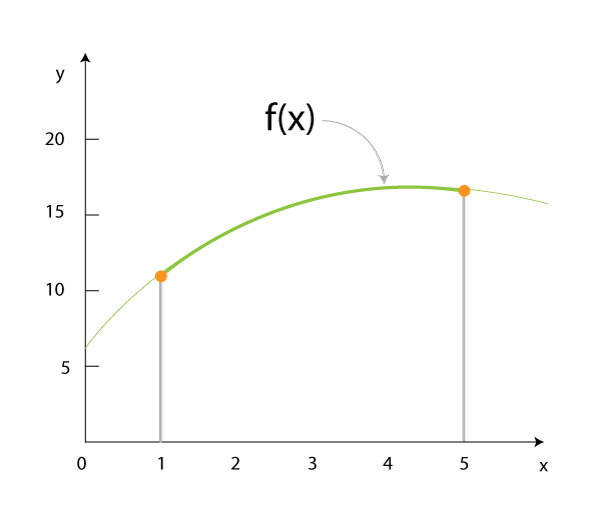
The best way to show it is “in simple terms,” or rather through an example. Suppose we want to find the area of a shape like the one in the picture (it’s called a curvilinear trapezoid because one side is created by a curved line). Why do we need this? For example, this could be part of an airplane wing, and we need to know its area.
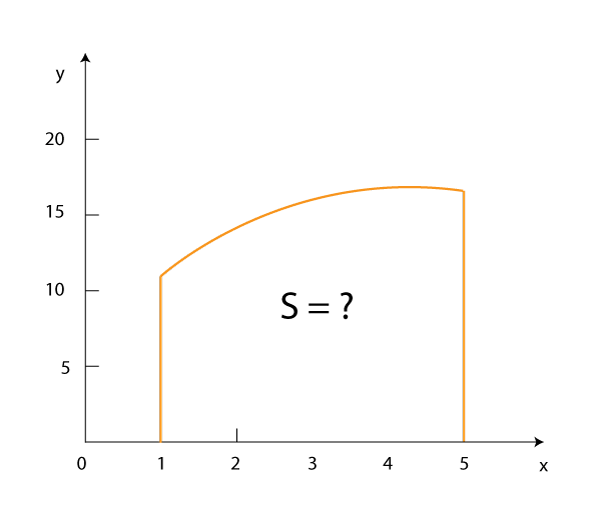
Of course, we can break the shape into a rectangle and a triangle.
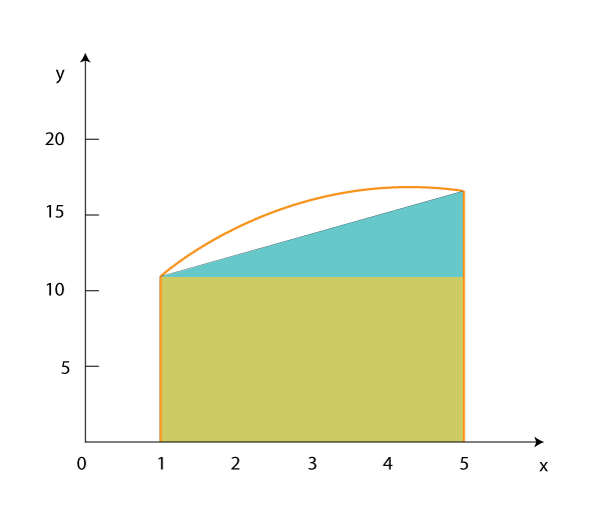
But there will still be a “gap” whose area will remain unknown. To increase accuracy, we can divide it into more shapes, but there will still be some, even if small, “unfilled” area. The shapes will become smaller and smaller… Clearly, the process of subdividing will be infinite, at least in imagination.
But in reality, an infinite process is simply unnecessary. In fact, calculating things like the area of a circle, the length of a square’s diagonal, or the volume of a pyramid is impossible; the value will be infinite, and practically speaking, infinite numbers have no real meaning, so we “round them” to the necessary accuracy limit — approximately.
This method was called “exhaustion” in Ancient Greece. The analogy with water is very fitting. Imagine you’re scooping from a bucket with a cup. Initially, the cups will be full, but as you get closer to the bottom, less and less water will be in the cup. The first person known to have “taken an integral” was Archimedes. He actually solved the problem of finding the area of a circle and the area of a parabola without knowing anything about limits, and not even about the number “pi”.
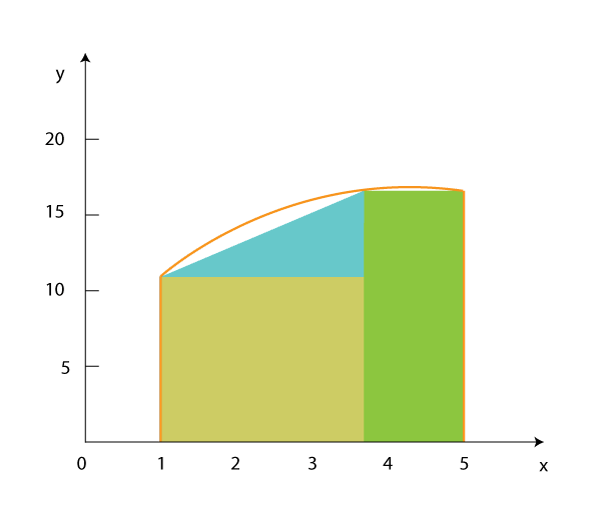
The more shapes there are, the greater the calculation accuracy will be, and the smaller the shapes will become. If the area of the small shapes is infinitely small, meaning it approaches zero (but never equals zero), the sum of all these areas will be equal to the area of the large shape with infinitely great accuracy.
The same thing happens when integrating:
The figure in the picture is broken down into columns of infinitely small width. The width is X. The infinitely small number is denoted as d. So dx is the infinitely small “x”.
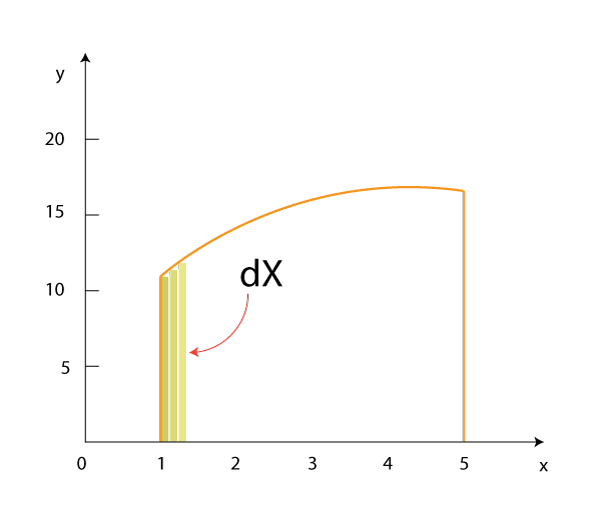
Summing an infinite number of parts of infinitely small size is what integration is.
To find the area of the figure, we also need the height, and that’s y. The height is not constant; it changes constantly. And we know exactly how! The curve may (or may not, but in our case it does) be a function y=f(x), meaning that the value of y changes according to the law (the letter f indicates this), depending on x. So “f of x.” This means that the height is f(x). By the way, the function is also infinite.
The height of a specific rectangle is the value of the function at this specific point (why point? Because the width of the strip is infinitely small, we agreed on this from the very beginning).
The area is the height multiplied by the width. We can take either y or f(x) as the height, as they are the same. The width is dx. And now, the moment of truth:
f(x)*dx or f(x)dx
f(x)dx — the area of our small column. If we sum them all up, we get the sum of infinitely small columns.
∫ f(x)dx
Now we just need to specify the exact value we’re interested in. Our curve is part of the parabola f(x)=x2.
∫ x2dx
But we need the area of the figure from 1 to 5. If we write these numbers above and below the integral sign, we get a definite integral.
That’s basically it. An integral is the sum of infinitely small increments (i.e., values) of a function. It’s not difficult or scary, as long as you don’t complicate things.
What do we do? We cut the figure into “strips,” change the area of these strips, and then sum them all up (integrate).
Interestingly, there is always talk of summation, but area is calculated by multiplication. A paradox? No, multiplication is just another form of addition: 2+2+2+2=2*4. The same thing happens with area. To find the area of a rectangle with sides 5 and 4, we multiply 5 by 4 or divide the rectangle into 5 strips, each 1 unit wide, and sum 4+4+4+4+4=5*4=20.
There’s no contradiction here. But multiplication works only for the same quantities, simple shapes, or straight-line movement without acceleration. In all other cases — integration.
Why is the integral needed?
From the example above, it’s clear that one of the useful tasks of integration is calculating the area of curvilinear shapes. In any complex situation, if the complexity lies in the curviness or unevenness, we use the integral.
But the best way to explain what an integral is in simple words is to show a few more examples. Just like when they explained addition with apples in childhood. So, for what can the integral be needed?
Suppose we need to build a temple for one of the ancient Greek gods, one that has enough space for everyone, with a rectangular roof and round columns because it’s prettier (that’s how they thought back then). The roof is a rectangle, so we can calculate the area using standard formulas. But the columns are round, so here comes the integral.