What are limits in simple terms
Limits are one of the most difficult concepts to understand in mathematics. It’s hard to explain simply what a limit is, so most often, no one tries.
And moreover, few teachers can give an example from life where limits might actually be useful. But we will try to explain it in a way that’s both clear and simple, as usual, “in simple terms.”

What are limits in simple terms
Probably the most illustrative example from history is the famous Zeno’s paradox “Achilles and the Tortoise.” Zeno was a philosopher, not a mathematician, so he could freely indulge in wit without worrying about proofs.
Achilles and the tortoise race. The tortoise starts first, and the human chases it. Achilles runs faster, but when he runs 100 steps, the tortoise still crawls one more. Another 100 steps, and another. Thus, Achilles approaches the tortoise, but she still distances herself slightly. Zeno concludes that Achilles will approach her infinitely but never catch her!
The important part of this story is not that it is unrealistic but its “mathematical meaning.” A person approaches the tortoise but never catches it. That is, a certain limit (the tortoise) to which Achilles is approaching.

In simple terms, a limit is a value that cannot be reached, but one can get infinitely close to it.
That is, in the limit of a given time interval, Achilles will indeed not catch the tortoise (time won’t be enough), but will get infinitely close to her.
What are limits in mathematics
It should be said right away that there is more than one definition of limits because they can be different. There is the limit of a sequence, and there is the limit of a function.
Let’s divide the number 10 in half:
10/2=5, and again, 5/2=2.5 and again…
This is the sequence n/2: 10…2.5…1.25…

If you do this 20 times, you get this value: 0.000019
And if you do it 100 times, you get: 0.000000000000000000000000000016
If you keep dividing by two infinitely, the result will get smaller and smaller, and in real life, this will effectively be zero, but in mathematics, it’s still not zero… The limit of this sequence will approach zero.
If we take another sequence, for example, n+1. 2…3…4…5… and again, we aim for infinity. The limit of this set will also tend to infinity.
Another example
We flip a coin. It can land “heads” or “tails.” Probability theory states that the odds are always 50/50, so the probability of “heads” is 1/2=0.5.
- If you flip the coin 10 times, it may not be 5 heads and 5 tails, but for example, 4 heads and 6 tails, which gives a probability of 0.4
- If you flip it 100 times, it could be 48 heads and 52 tails, giving a probability of 0.48
- If you flip it 1000 times, it could be 499 heads and 501 tails, giving 0.499
- 10,000 flips — 4998 heads and 5002 tails, giving 0.4998
Each time, the value of the actual probability approaches the calculated 0.5. To get a probability exactly equal to 0.5, you would need to flip the coin an infinite number of times.
That is, given that the number of flips tends to infinity, the limit will be 0.5.
This is the same infinity from mathematical analysis mentioned in the articles about integrals and division by zero. It is not a specific number, but a concept.
Limit of a sequence
The limit of a sequence is the space that contains all elements of the sequence starting from a certain value.
In simple terms, the limit of a sequence is the “area” into which all values after a certain threshold (in our case — A) fall. In the image below, it’s shown as the blue line.
Starting from the 13th value, all subsequent values are so close to each other that they fall within this limit. Although, of course, they are not equal to it, but “oscillate” back and forth by an infinitesimally small amount ε. In the picture, it shows +ε and -ε. Almost all terms of the sequence, except for the first 13, are within the interval (s-ε; s+ε).

ε — is an arbitrary positive number.
It can be noticed that as the sequence continues upwards, its values will still stay within the “blue line”.
It can also be stated like this:
The limit of a numerical sequence is a number (s on the graph) around which an infinite number of values lie. Outside the limit, the number of values is clearly finite.
To make it even clearer: the limit of a sequence is a value (point A) above which all values fall into an area no greater than s+ε and s-ε. An infinite number of such values will “lie” inside the blue line.
Mathematically, this can be written as: s-ε < xn < s+ε or |xn– s| < ε
That is, all points will be within a strip of width 2ε on the sigma right and sigma left. The further upwards, the closer the values will be to s, but they will not “fall out” of + or – sigma. The definition of a limit in mathematics is not necessarily difficult; it is counterintuitive. One has to use imagination to understand that, in fact, it is simple and clear.
If it’s still too “mathematical”, let’s try to explain in layman’s terms:
The simplest explanation is this. The limit of a sequence is such a value that all its terms “almost hit”. A kind of virtual ceiling that cannot be reached, although there’s always just a little bit left.
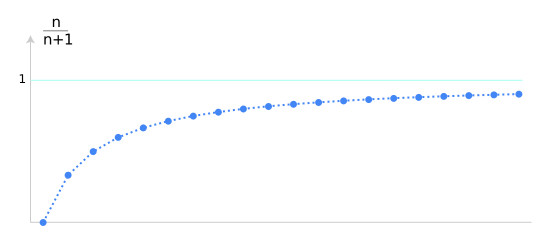
For example, consider the sequence n/n+1. Here, you can see that no matter what value of “n” you substitute, the denominator will always be one more. Take “one” 1/1+1=0.5, take “ten” 10/10+1=0.909, take “twenty” — 0.952, take “one hundred” — 0.990099. No matter what number we substitute, the value will always approach one, but it will never equal one.
Limit of a function in simple terms
In fact, it’s the same thing. The only difference is that a sequence of numbers has gaps, while a function does not, it is continuous. But this doesn’t fundamentally change the essence.
Explaining the limit of a function in simple terms is just as easy. The limit at some arbitrary point is the value that the function approaches. For example, f(x)=2x, and x→0 (x tends to zero).
In this case, the limit of the function will be lim 2x=0. Or if x→2, the limit will be lim 2x=4. So far, everything is simple. But why calculate limits when you can simply drop the “lim” and the calculations remain the same?…
Why limits are needed
Limits are necessary when we deal with infinity. For example, infinitely large or infinitely small values.
It’s unclear what “infinitely large” or “infinitely long” means; it is not a specific number. The same goes for infinitely small values; it’s not “zero”, but something very close to it. This is where limits come in handy.
Here is a graph that will appear if we take the function y=x2-4/x-2

At the point x=2, there is nothing. This is because you get 0/0, which is indeterminate. But if instead of 2, you substitute 1.9999999999(9) or 2.000000001(1), values infinitely close to 2 but not exactly “two,” the graph will transform into a straight line.
In this case, we are talking about the limit of the function as “x” approaches two, and the function approaches 4.
lim x2-4/x-2
as x→2 lim x2-4/x-2→4
This is a kind of “trick” in calculations, where the equality sign is replaced with an arrow.
No, not quite. When we talk about limits, we mean a process, whether it’s a function or a set, but the limit describes the process dynamically. Whereas the equality sign indicates a static state.
x=1 and x→1 are not the same thing.
Examples from real life
Why are limits necessary? Where are limits used in real-world calculations?
A simple explanation of limits is impossible without a visual example. But where can you find one? Does a physical meaning for limits exist? While not an exact analogy, there is something similar.
You can conduct a simple experiment, for example, with a matchstick or anything else that you don’t mind breaking. Start trying to break the matchstick, first applying one force, then a little more, and then more and more. At one point, the matchstick will snap in half.
Congratulations, you’ve reached the limit of the matchstick’s strength. You can repeat the experiment with other matchsticks and determine the value at which the matchstick breaks.
What does this have in common with mathematical limits, aside from the name?
There are many values of force up to the limit of strength, and they are finite, and there are an unlimited number of values beyond the limit. Since the matchstick has already broken, any force above the strength limit will break a new matchstick. Just like with the limit of a function or set.
Everything beyond the limit no longer has practical value — the matchstick will not withstand it.
Another example is the “practical ceiling” of an aircraft. This is the maximum height that an aircraft can “climb.” To rise higher, there will no longer be enough lift. Although there is also the concept of “dynamic ceiling” — the height that can be reached by accelerating well.
However, once reaching this height, the aircraft will eventually fall back to its “ceiling.”
Look at the picture below; it is a vivid example of a phenomenon called resonance.

Bridge oscillation due to resonance
The bridge oscillates because its natural frequency of oscillation coincides with the frequency at which the wind shakes it, causing the amplitude of oscillations to grow continually, leading to the destruction of the bridge. In this case, the amplitude tends to infinity, because the formula’s denominator contains an expression w0-w (natural frequency of oscillation minus the forced frequency), and since both w are equal, this leads to division by zero, meaning the amplitude → ∞.
A very understandable real-world example of limits is complex banking interest on loans. If you don’t know how to calculate compound interest, don’t take out a loan. For those proficient in mathematical analysis, this advice is also valuable.
Limits might also be necessary when calculating the marginal cost of a product, knowing the relationship (function) between price and sales volume, or the marginal production volume, or many other things.
Perhaps the most vivid example is the limit in marketing. Here’s the relationship between the cost per click and the number of clicks in contextual advertising.

It is evident that the limit of this function tends to 30 clicks as the cost per click tends to infinity. Even without knowledge of mathematical analysis, it becomes clear that even when increasing the bid for a click to $4 or $5, it will not be possible to achieve more than 30 clicks. And if that’s the case, why raise the bids?
Still, in everyday life, an ordinary person rarely encounters the concept of a limit of a function or sequence. That’s why it’s so difficult to understand and accept abstract mathematical formulations.
But if you try, mathematics can open new dimensions of reality, and at least, it will no longer seem so boring and incomprehensible.