The Story of Zero
Who invented zero? For those who want a quick answer, I’ll say right away — zero was invented by Indian mathematicians. That’s what the official history of mathematics states. But for those who are more curious and willing to read this article to the end — zero was invented not only by Indian mathematicians. It was simply a slightly different zero.

Zero rupees! Used to fight corruption.
But let’s return to the history of the number zero and the digit zero. The digit zero we use today came to us together with Arabic numerals, which Arab mathematicians adopted from India. In other words, it was in India that the decimal positional system was invented. But how could people count without zero before? They both could and couldn’t at the same time. Something resembling zero can be found even on the clay cuneiform tablets of ancient Babylon…
Is zero a digit or a number?
The digit 0 and the number 0 are slightly different concepts. Zero (the digit) is the symbol used to represent “zero” (the number). While it’s fairly clear with digits that 0 means nothing, understanding the number is a bit more complex. Moreover, even with an understanding of “nothing,” it’s entirely possible to manage without zero in mathematics.
The history of the digit 0
For example, the Babylonians, without knowing about the digit zero, could still distinguish between numbers like 202 and 22. Although they used a sexagesimal number system, unlike our decimal one, they intuitively grasped what zero meant. In an empty position, they would record either three “hooks” or two wedges to signify absence. This was done as early as around 300 BCE.
Zero as a digit doesn’t always mean “nothing.” For example, in a positional system, 0 by itself means “nothing is there,” which is clear, but in 100 (one hundred), the 00 indicates the absence of a number in those positions.
The ancient Greeks had no concept of zero. This is because they primarily used numbers for practical geometric purposes, and a line segment of zero length had no practical value. In astronomical calculations, they used the letter “omicron” (όμικρον), the first letter of the word “ouden”, meaning “nothing,” written as O (a circle). But it signified… not zero, but 70! The Greeks used an alphabetic system for writing numbers.
The Romans also knew nothing of zero. Writing the number 388 in Roman numerals gives CCCLXXXVIII, with no concept of place value. How do you write 0 in Roman numerals? The answer is — you can’t.
So how did the digit 0 come about? In both ancient Greece and Egypt, pebbles were used for counting. When a pebble was lifted from its place during counting, it left an empty spot. Isn’t that zero? Not quite yet. Everything before the Indians was purely practical and cannot be considered the true history of zero’s invention. It was merely a way to mark an empty space. But zero is both a digit and a number.
A system of decimal places also existed in China. To represent the number 934, they would place 4 sticks in the units column, 3 in the tens, and 9 in the hundreds. Instead of zero, they left an empty space. However, when writing numbers, the Chinese did not use place values and had no symbol for zero.
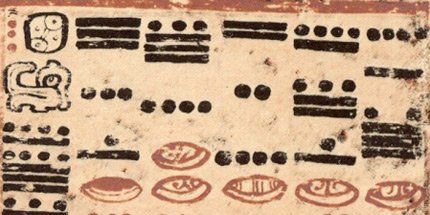
The now-popular Maya Indians also had their own zero in their vigesimal (base-20) number system, a thousand years before the Indians. But the Maya zero didn’t mean zero as we understand it; it signified “the beginning.” The count of days in the Maya calendar started with a zero day called “Ahau.”
The neighboring Incas used quipu, a system of knotted cords, where numbers from 1 to 9 were represented by different knots, and zero was indicated by an empty space.
The invention of the number zero
When and how did zero emerge in its modern sense? What exactly did Indian mathematicians invent? They initially denoted zero with a dot to indicate a missing number, and later with a circle. Most importantly, they defined zero not as the mere absence of a number, but as a number!
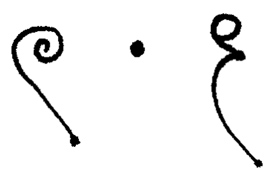
Early Indian zeros
Around 500 CE, the positional numeral system was developed, and a record concerning the use of zero dates to 876 CE. This offers an answer—though somewhat uncertain—to the question “when did 0 appear?” This is the real zero we know today.
Indian mathematicians Brahmagupta, Mahavira, and Bhaskara wrote that subtracting a number from itself yields “zero.” This is the familiar definition of the number zero. Now, zero is a number. It’s used in calculations and even written as a small circle.
With just 10 digits, you can write any number, no matter how large. This was a revolution in mathematics.
The Indians called zero “sunia”, meaning empty. The Arabs translated it as “sifr”. Incidentally, zero, a rather mysterious number, led Indian mathematicians to discover that dividing by zero yields infinity, and if you raise zero to the power of zero, you get one. But those are other stories…