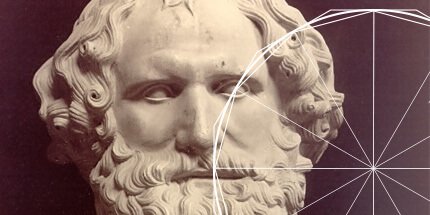
Squaring the Circle
There is one remarkable mathematical problem in history, which evolved from a simple mental exercise for the philosophers of ancient Greece into a very complex issue that had a significant impact on science on a large scale…
Although it was never solved. At first, everything seemed simple: how can you draw a square with the same area as a circle?
Squaring the circle problem
The problem of squaring the circle had no particular practical value for ancient mathematicians. The Egyptians knew the relationship between the diameter of a circle and its area. In Egypt, the area of a circle was calculated as: S=(8/9*d)2.
But since land plots were measured in “squares,” this level of accuracy was sufficient.
However, the Greeks, well-versed in “Egyptian mathematics,” posed the question of how to construct a square using only a compass and a ruler. They set out to find an answer. It turned out to be quite complicated. First, it was necessary to determine how to calculate the area of a circle in the first place.
What is squaring the circle in simple terms?
It is the problem of how to construct a square with the same area as an already existing circle using a compass and a ruler. From a practical perspective, it can be seen as a way to find the area of a circle. After all, if we can draw a square with the same area as the circle, it’s easier to calculate the area of the square.
But the ancient mathematicians were more interested in the intellectual challenge, to be the first to solve this difficult problem.
The problem was tackled by Hippocrates, Anaxagoras, Dinostratus, and Archimedes, but no one was able to propose a final solution.
Although what Archimedes did was far ahead of its time. The great scientist, in his work “Measurement of the Circle”, derived three theorems.
Archimedes’ Solution
Where does the area of a circle come from?
From a triangle
The area of a circle is equal to the area of a right triangle, if one of its legs is the radius, and the other is the length of the circumference. This is easy to explain. If you take a circle and cut it (better in your mind) into smaller circles, you can fit them into a triangle.
In the figure below, you can see that the blue circle “unfolds” into a straight line that is longer than the red one. So, each new strip will be shorter than the previous one. The longest one is BC in the triangle, which is also L, that is, the length of the circumference.

Area of a circle and triangle
Now, let’s calculate the area of the triangle: S=(AB*BC)/2. This is the same as S=(R*L)/2. Everything is correct. But what is the length of the circle? We know that it is the diameter (or 2 radii) multiplied by pi, but how did Archimedes know this? And more importantly, how could you draw a line of length “pi” using a ruler?

Squaring the circle
If you take a circle and “cut” it into 4 parts, you will get 4 equal isosceles “triangles” (only one side will not be straight). Two sides will equal the radius (the red lines), and the third will be 1/4 of the length of the circumference.
Next, we gather the 4 parts together as shown in the figure above. Radius to radius. We get an interesting shape. Two straight sides and two curved ones. The straight ones are the radii, and the two “waves” at the top and bottom will equal half the length of the circumference. What does this resemble? A skewed parallelogram. But this is just the beginning.
We start dividing the circle into smaller parts and reassemble them. We get almost a rectangle, with the sides still being R, and the top and bottom parts remaining the same waves, with the same length L/2.
But with each division, the “bumps” get smaller and smaller, and soon they become almost invisible. You need to keep dividing until it turns into an almost rectangle.
When the pieces are so small that it becomes a rectangle, its area can be easily calculated by multiplying the length of one side by the length of the other (a*b). In the example above, the side “a” is R (the radius of the circle), and the side “b” is L/2 (length), assuming that the parts of the shape are infinitely small and there are infinitely many of them. The area of the circle is:
S=R*L/2
The length of the circumference (L) is equal to the diameter multiplied by the number “pi” (π). So, L=π*d=π*(R+R)=2πR. But back then, they didn’t know such numbers, unfortunately.
And if we substitute L, we get:
S=R*(2πR/2)=πR2
Archimedes did not know the number “pi” and could not have known, because it is irrational (this would only be proven in the 19th century), and such numbers were not discovered in his time.
The famous mathematician preferred a slightly different solution, using a spiral. But what’s interesting is that Archimedes’ method is essentially an integral. In fact, it is very difficult to draw an irrational number using a ruler. Imagine that the diameter is 1, then the length of the circumference is “pi,” and now try to draw a segment of that length (this is an infinite fraction).
From Motion
Another Greek, Hippocrates of Chios, created a special curve for solving the same problem, the quadratrix. This was just as much an “ancient integral” as it was ahead of its time.

The Middle Ages and a Little Later
Esteemed scientists such as Fibonacci of Pisa, Leonardo da Vinci, Huygens, and Kepler trained their minds by tackling this nontrivial problem…
Leonardo da Vinci’s Cylinder
The famous scientist proposed a very clever solution. As usual, it was “mechanical.” Leonardo suggested taking a cylinder, whose height would be half the diameter of the circumference. Then, this cylinder should be dipped in ink (you can imagine this) and rolled over a piece of paper once.

Squaring the circle Leonardo da Vinci
This will result in a rectangle whose height will be half the radius R/2, and the width will be the length of the circumference (since we rolled the cylinder once). And the area of this rectangle is easily calculated:
S=R/2*L=R/2*2πR=πR2
This is as simple as it gets, a ruler and a compass are all that’s needed… But what is the “length of the circumference”? We know now the properties of the number “pi,” but what did people of the past know?
But in da Vinci’s case, there was no need to know anything, it was enough to measure the long side of the rectangle with a ruler to determine the length of the circumference, no “pi” required.
Has squaring the circle ever been solved?
Eventually, the Paris Academy refused to consider solutions to the problems of squaring the circle, trisection of angles, duplicating cubes, and… inventing a perpetual motion machine. For some, it’s entertainment, for others, it’s writing reviews and reading them.
In the 19th century, it was proven that the number “pi” is irrational and transcendental, which means that the square root cannot be extracted from it.
So, if you take a circle with a diameter of 1, the equation x2=πR2 turns into x2=π, and x itself equals “the square root of pi,” but that can’t be done. Hence, it is concluded that a ruler and a compass are not enough to solve the problem of squaring the circle.
Consequences of the Unsolved Problem of Squaring the Circle
So, what did we end up with? “Making a square from a circle” is not possible. The problem cannot be solved, and this has been proven, but how much interesting material it contributed to mathematics and geometry:
- Irrational numbers (pi)
- Transcendental numbers (also pi)
- The quadratrix
- “Almost” integration
- A multitude of ingenious (and not so much) solutions
Sometimes, solving unsolvable problems is beneficial to humanity; the outcome often brings much more useful knowledge than if the problem had been solved.